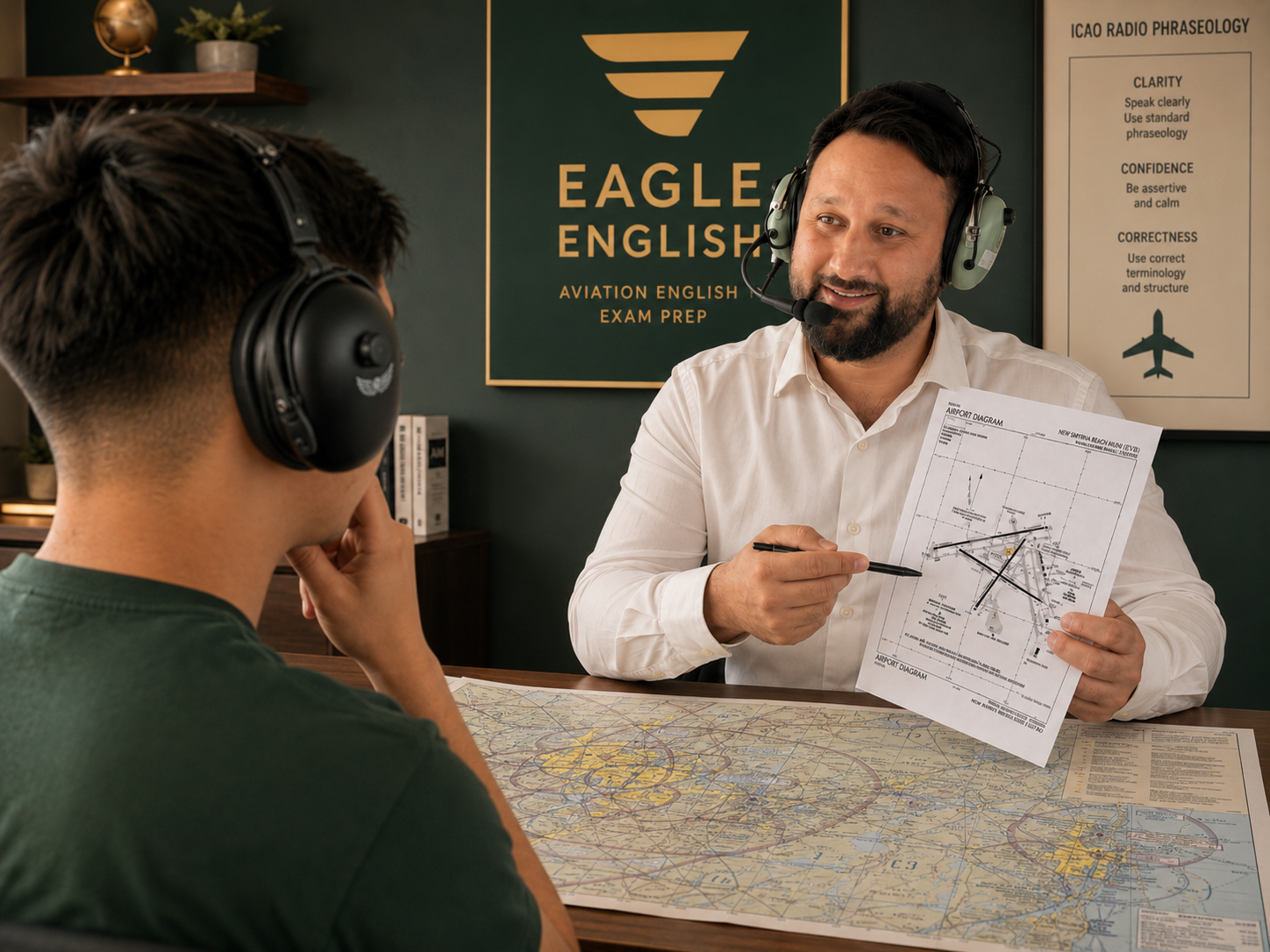
Every week I watch intelligent student pilots freeze during oral exams.
They know the material.
They've flown the maneuver.
They've answered the questions correctly in ground school.
Yet the moment they're asked to explain their thinking in English, the conversation often slows to a halt.
At first glance, this doesn't make much sense. Many of these students speak English comfortably in everyday life. So why does it happen?
If someone speaks English well in everyday conversation, you would probably expect them to succeed in aviation too, right? That has not been my experience. I have worked with student pilots who can easily talk about their family, home country, weekend plans, and even aviation topics with relatively few errors. As soon as I present them with an ATC communication scenario or ask a realistic checkride question, however, the conversation often comes to a halt.
Why Does This Happen?
I know these students. They have studied the material, flown the maneuver, and answered these questions correctly in ground school. The problem usually isn't a lack of knowledge.
The problem is that aviation places communication inside a time-sensitive, high-workload environment. When students begin translating every thought into English while simultaneously trying to fly the airplane, monitor instruments, think ahead, and make safe decisions, something has to give.
Their brains naturally prioritize the physical and cognitive demands of flying, and communication is often the first thing to suffer. Once that cycle begins, confidence quickly follows. Students hesitate, restart sentences, search for perfect words, and often make mistakes they would never make in a relaxed classroom conversation.
Knowledge Isn't the Problem
After watching this happen repeatedly, I have become convinced that passing an oral exam is not simply about knowing English vocabulary.
If it were, we could hand students a textbook, ask them to memorize hundreds of aviation terms, and expect them to perform well during a checkride. We know that approach doesn't work.
Resources such as Sheppard Air are extremely effective for preparing students for FAA knowledge exams, but memorization alone cannot prepare someone for real-time communication.
Pilots are constantly processing information, making decisions, prioritizing tasks, and explaining their thought process. Even native English speakers can struggle to organize their thoughts under that kind of pressure. It should not surprise us that communicating in a second language becomes significantly more difficult.
Aviation English Is Different
For that reason, I have come to believe that Aviation English should not simply be viewed as another branch of English language instruction.
It deserves to be treated as its own discipline because the communication demands placed on pilots are fundamentally different from those found in most everyday conversations.
Aviation English should provide students with opportunities to communicate in realistic situations that reflect the environments in which they will eventually operate. The goal is not simply to know aviation vocabulary; it is to communicate effectively while managing the workload of flying.
The Goal Isn't Perfect English
One of the most common patterns I see is that students stop communicating as soon as they cannot immediately think of the perfect word.
Instead of continuing with the language they already know, they begin translating, restart the sentence several times, and become increasingly frustrated. Ironically, many of those students could have communicated their idea successfully if they had simply continued speaking.
In aviation, effective communication is almost always more valuable than perfect communication.
I would much rather hear a pilot communicate slowly and clearly than hear someone repeat the same incorrect phrase four times because they are trying to make it sound perfect.
Teaching Communication Under Pressure
That realization has changed the way I teach.
Early in my career, I spent much more time correcting grammar and expanding vocabulary. Those skills still matter, and they always will.
Today, however, I spend much more time creating realistic scenarios that require students to think, solve problems, and communicate under pressure.
Rather than memorizing answers, students learn to explain decisions. Rather than completing vocabulary lists, they practice entire situations that resemble the conversations they will eventually have with instructors, examiners, air traffic controllers, and other pilots.
My objective is no longer to help students produce perfect English. It is to help them become confident communicators when the workload is high.
Final Thoughts
One of the most rewarding moments as an instructor is watching a student stop worrying about speaking perfect English and begin communicating like a pilot.
Confidence begins replacing hesitation, and communication becomes part of the decision-making process instead of another obstacle to overcome.
At EAGLE English, our motto is “Soar Above with Confidence.” For me, that idea extends far beyond passing a checkride.
Confident communication helps pilots make better decisions, work more effectively with others, and ultimately contributes to safer flight operations for everyone who shares the airspace.